
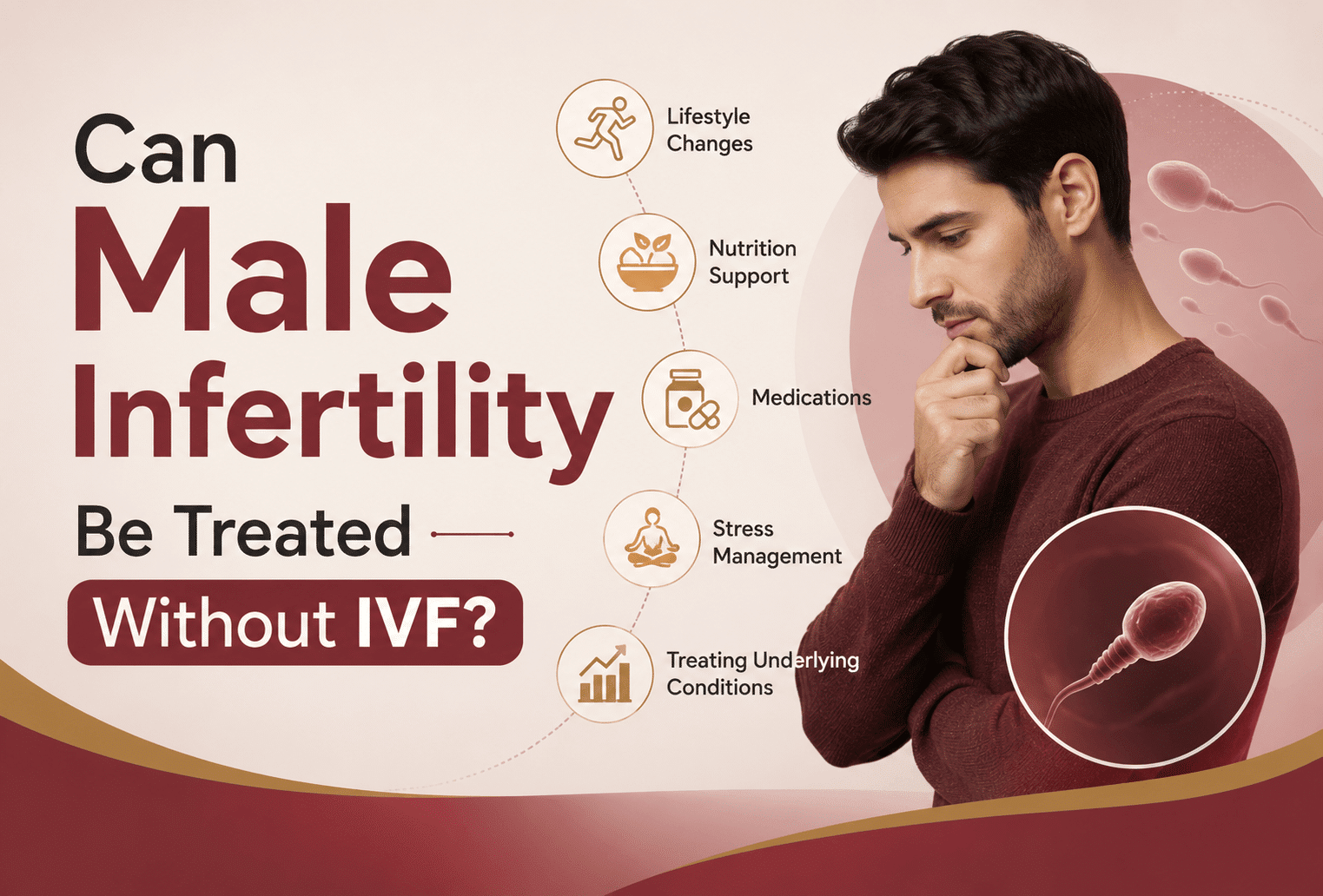
Can Male Infertility Be Treated Without IVF? Understanding Your Options
One of the most common assumptions couples make after a diagnosis of male infertility is that IVF is inevitable. In clinical practice, that is rarely the starting point.
In reality, male factor infertility contributes to 40–50% of all infertility cases globally, and a meaningful proportion of these cases involve potentially reversible or manageable causes, particularly in early or moderate stages as per World Health Organization.
The challenge is not the lack of treatment options. It is identifying which option is actually meaningful for a given patient.
The real clinical question is not whether IVF can be avoided. It is whether there is enough biological potential to justify treatment before IVF, and whether there is enough time to attempt that treatment without compromising outcomes.
That is where a clear understanding of male infertility treatment options becomes critical.
What a Semen Report Tells You and What It Doesn’t?
Most treatment decisions begin with a semen analysis, but this is often misunderstood as a final diagnosis. In reality, it is only a functional snapshot.
A semen report measures:
- Sperm concentration
- Motility
- Morphology
What it does not directly measure is:
- Sperm DNA integrity
- Oxidative stress burden
- The efficiency of spermatogenesis
- Underlying endocrine control
Clinical guidelines from American Society for Reproductive Medicine emphasize that semen analysis is a screening tool, not a complete diagnostic endpoint, which explains why patients with “near-normal” reports may still experience infertility or failed treatment outcomes. This is why two men with similar reports can have very different fertility outcomes. One may conceive naturally with time, while another may fail repeated IVF cycles.
This is the first important principle: A report does not define prognosis. The underlying biology does.

How Doctors Actually Classify Male Infertility
In practice, fertility specialists do not think in terms of labels like “low count” or “poor motility” alone. They look at mechanism.
Broadly, male infertility falls into three functional categories.
Functional causes (potentially reversible)
These include oxidative stress, metabolic issues, and mild hormonal disturbances.
These cases are the best candidates for male infertility treatment without IVF
Structural causes (partially reversible)
Conditions like varicocele or ductal issues fall into this category.
Evidence suggests that varicocele is present in up to 15% of the general male population and up to 40% of infertile men, making it one of the most common correctable causes. European Association of Urology
Primary testicular or genetic causes (limited reversibility)
These include severe spermatogenic failure or genetic abnormalities.
In such cases, IVF or ICSI is often the more effective starting strategy.
Understanding which category a patient falls into is what determines whether male infertility treatment without IVF is a meaningful strategy or simply a delay.
Getting pregnant is now easier
Book IVF Consultation
The Role of Oxidative Stress in Male Infertility
One of the most consistent findings across fertility research is the role of oxidative stress in sperm dysfunction.
Research published in Human Reproduction Update has shown that oxidative stress is involved in a significant proportion of idiopathic male infertility cases.
Reactive oxygen species (ROS), when present in excess, damage:
- Sperm membranes
- Mitochondrial function
- DNA integrity
This has direct implications for:
- Sperm motility
- Fertilization capacity
- Embryo development
Clinical studies have shown that oxidative stress is involved in a large proportion of idiopathic male infertility cases. This is why interventions aimed at reducing oxidative damage, through lifestyle changes or antioxidant support, are often included in lifestyle treatment male infertility plans.
However, an important nuance is often missed.
Reducing oxidative stress improves the environment. It does not always restore spermatogenic capacity in severe cases.
This distinction is what prevents over-reliance on lifestyle-only strategies.
Hormonal Control of Sperm Production: When Therapy Actually Works
Spermatogenesis is tightly regulated by the hypothalamic-pituitary-gonadal axis. Disruptions at any level can reduce sperm production. Guidelines from the American Urological Association indicate that hormonal therapy can restore spermatogenesis in properly selected patients.
In conditions such as hypogonadotropic hypogonadism, the testicles are capable of producing sperm but are not receiving the correct hormonal signals. In these cases, hormone therapy male infertility treatment can be highly effective.
Clinical outcomes in properly selected patients can be significant, with restoration of spermatogenesis over time.
However, in men with primary testicular failure, where the testicular tissue itself is impaired, hormone therapy has limited benefit.
This is why endocrine evaluation is not optional. It is central to deciding whether hormonal treatment is likely to work.
Medication in Male Infertility: Targeted, Not Universal
The idea that medication can “boost fertility” is widespread, but clinically inaccurate.
Medication is effective only when it is directed at a specific pathology.
For example:
- Antibiotics are useful in documented infections affecting semen parameters
- Anti-inflammatory therapy may help in selected inflammatory conditions
- Antioxidants may reduce oxidative damage in appropriate patients
What medication cannot do is:
- Reverse severe testicular dysfunction
- Correct structural abnormalities
- Compensate for genetic defects
However, large-scale reviews suggest that antioxidant therapy shows variable outcomes, and benefits are often dependent on patient selection and underlying cause. Cochrane Database of Systematic Reviews. This is why medication for male infertility must be used selectively, not as a blanket solution.
Varicocele: One of the Few Correctable Structural Causes
Conditions like varicocele or ductal issues fall into the structural causes.
According to the European Association of Urology, varicocele repair can improve semen parameters in selected patients and may enhance fertility outcomes.
Evidence suggests that varicocele is present in up to 15% of the general male population and up to 40% of infertile men, making it one of the most common correctable causes. European Association of Urology
Varicocele remains one of the most clinically relevant and treatable causes of male infertility.
It is associated with:
- Increased scrotal temperature
- Impaired blood flow
- Elevated oxidative stress
Surgical correction has been shown to improve sperm parameters in selected patients, particularly when:
- Varicocele is clinically significant
- Semen parameters are abnormal
- Female factors are not limiting
However, not all varicoceles require treatment, and not all patients benefit equally.
This is where surgical treatment male infertility becomes a matter of selection, not routine intervention.
Sperm DNA Damage: The Limiting Factor in Many “Unexplained” Cases
A growing body of clinical evidence highlights the role of sperm DNA fragmentation in cases where conventional parameters do not explain poor outcomes.
High DNA fragmentation has been associated with:
- Reduced fertilization rates
- Impaired embryo development
- Increased miscarriage risk
This explains why some couples experience repeated IVF failure despite seemingly acceptable sperm count and motility.
Treatment strategies here overlap with other areas:
- Reducing oxidative stress
- Correcting varicocele
- Addressing inflammation
But there is an important clinical boundary. DNA quality can improve. It cannot always be normalized completely. This is often the point where IVF, particularly ICSI, becomes part of the treatment pathway.
Guidelines from American Society for Reproductive Medicine acknowledge its role in selected cases, particularly when conventional semen parameters do not explain outcomes. This is a crucial part of advanced male infertility treatment options.
The Time Factor: The Most Underrated Variable
One of the biggest mistakes in male infertility management is ignoring time.
Sperm production takes approximately 70–90 days, which means any treatment requires at least 2–3 months before meaningful reassessment.
However, this timeline must be balanced against:
- Female partner’s age
- Ovarian reserve
- Duration of infertility
In younger couples with mild issues, waiting for improvement is reasonable.
In older couples or those with repeated failure, delaying effective treatment may reduce overall chances.
This is where the question shifts from:
“Can we treat this?”
to
“Should we spend time treating this?”
When IVF Is Not Escalation, But Optimisation
There is a tendency to view IVF as a last resort. Clinically, this is not always accurate.
In many situations, IVF or ICSI is simply:
- The fastest route to pregnancy
- The most predictable outcome
- The most efficient use of time
This is especially true in cases of:
- Severe sperm abnormalities
- Persistent DNA damage
- Genetic factors
- Failed prior treatments
Understanding when IVF is required for male infertility is not about giving up on treatment. It is about choosing the most effective strategy at the right time.
A More Practical Way to Approach Male Infertility
Instead of asking:
“Can this be treated without IVF?”
A more clinically relevant question is:
“What gives the highest probability of pregnancy within the time we have?”
That answer is different for every couple.
Consultation with Dr Rhythm Gupta at Excel IVF
Male infertility is rarely about a single test or a single treatment decision. It is about understanding the biology behind the condition and choosing the right path based on that understanding.
At Excel IVF, evaluation is structured to determine:
- Whether the condition is reversible
- How much improvement is realistically possible
- Whether time should be invested in treatment or directed toward assisted techniques
This approach ensures that patients are not left choosing between extremes, but are guided toward the most effective male infertility treatment options for their specific situation.
If you are trying to decide whether IVF is necessary or whether treatment can be attempted first, a detailed evaluation can help bring clarity to that decision.
FAQs About Male Infertility Treatment Options
Yes. Many cases can be managed with male infertility treatment options such as lifestyle changes, hormone therapy, medication, or surgery—especially when the cause is mild to moderate and reversible. IVF is considered when these options are unlikely to be effective or time is limited.
The primary male infertility treatment options before IVF include lifestyle treatment, hormone therapy for hormonal imbalance, cause-specific medication, and surgical treatment like varicocele repair. The right approach depends on diagnosis, not just symptoms.
Doctors assess severity, cause, and time factors. IVF or ICSI is recommended when sperm count or motility is severely impaired, DNA damage remains high, genetic issues are present, or when non-IVF treatment is unlikely to improve outcomes in time.
Most male infertility treatment options require at least 2–3 months to show improvement, as sperm production follows a 70–90 day cycle. Timelines may be longer depending on the cause and response.
Lifestyle changes can significantly help in lifestyle treatment male infertility, particularly in mild cases driven by smoking, obesity, stress, or poor sleep. However, they are often not sufficient in moderate to severe conditions.
Hormone therapy male infertility treatment is used when tests show hormonal imbalance, such as low testosterone or disrupted FSH/LH levels. It can stimulate sperm production but is only effective when guided by proper diagnosis.
Medication for male infertility includes antibiotics for infections, anti-inflammatory drugs, and antioxidants for oxidative stress. Medications are effective only when tailored to the underlying cause.
Yes, in selected cases. Surgical treatment male infertility, such as varicocele repair, can improve sperm production and quality when a clinically significant varicocele is present.
In some cases, yes, especially with lifestyle correction and reduced oxidative stress. However, natural improvement is not guaranteed, and delays without diagnosis can reduce treatment success.
You should consult a male infertility specialist in Delhi if you have been trying to conceive for 6–12 months without success, have abnormal semen parameters, or have experienced repeated IVF failure or miscarriage.
There is no single best treatment. The most effective male infertility treatment options depend on the cause, severity, and time available, and may range from lifestyle and medical therapy to IVF or ICSI.
No. IVF is not always required. Many men respond to male infertility treatment without IVF, but IVF or ICSI becomes the most effective option in severe or time-sensitive cases.

Dr. Rhythm Gupta
Consultant Obstetrician,
Gynaecologist & Infertility Specialist,
MBBS, M.S Obstetrics & Gynaecology
At Excel IVF, we don’t just treat tests and parameters. We partner with you through the emotional, scientific, and medical journey of fertility. Here, Dr. Rhythm Gupta, the leading IVF specialist in Delhi, shares insights from her years in reproductive medicine, breaking down myths, best practices, and what matters most in your path to becoming a parent.
Book a consultation today to understand better and begin your parenthood journey. Call: +91-8920963596 or Email Us: excelivf@gmail.com