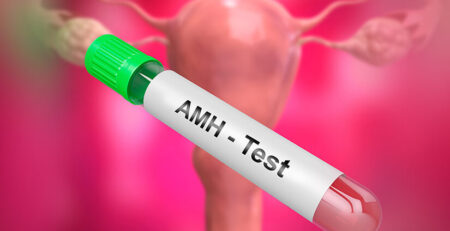
Low AMH and Pregnancy Chances: What the Numbers Actually Mean
By Dr Susheela Gupta and medically reviewed by Dr Rhythm Gupta, MBBS, MS (Obstetrics & Gynaecology), Fellowship in Clinical ART, Consultant & Fertility Specialist, Excel IVF, Delhi.
Yes, you can get pregnant with low AMH. In many cases more easily than the number itself suggests. AMH is one of the most misunderstood tests in fertility medicine, and a low result is often read as a verdict on natural conception when the evidence does not support that reading. This guide explains what AMH measures, what it does and does not predict, and what to do when it comes back low.
What AMH Is, and What It Is Not?
AMH (anti-Müllerian hormone) is produced by the small follicles in your ovaries. The blood level gives a fairly stable indication of how many follicles you have in reserve. It correlates well with the antral follicle count seen on ultrasound, and it is one of the best markers we have for ovarian reserve, which is the size of your follicle pool.
Here is the crucial distinction the test often gets confused on: AMH tells you about quantity, not quality. It is a strong predictor of how your ovaries will respond to IVF stimulation (more eggs collected when AMH is higher) and of how close you are to menopause. It is a much weaker predictor of natural conception in women who are still ovulating regularly. Several large studies, including the Time to Conceive study and a 2024 retrospective analysis of over 500 women, have shown that women with low AMH and regular cycles conceive naturally at similar rates to women with normal AMH of the same age.
This matters because a low AMH on its own, in a woman with regular periods and otherwise normal workup, is not a reason for IVF or panic. Age, ovulation, tubal patency and partner factors usually matter more for immediate natural-conception chances.

AMH Ranges, and What “Low” Means
There is no universally agreed cut-off, and AMH naturally declines with age, but the following ranges are used in most fertility hospital:
- Above 4.0 ng/mL: high (often seen in PCOS).
- 0 to 4.0 ng/mL: normal for most women of reproductive age.
- 5 to 1.0 ng/mL: low, but with significant variation in what this means depending on age and clinical picture.
- Below 0.5 ng/mL: very low, typically described as diminished ovarian reserve (DOR).
The Bologna criteria for poor IVF response use AMH below 0.5 to 1.1 ng/mL (or fewer than 5 to 7 antral follicles). AMH falls naturally with age: roughly 4.0 ng/mL in the late 20s, 2.0 to 3.0 ng/mL in the early 30s, 1.0 to 1.5 ng/mL in the late 30s, and under 1.0 ng/mL approaching 40. A 28-year-old with AMH 1.0 ng/mL is in a very different position from a 40-year-old with the same number.
Getting pregnant is now easier
Book IVF Consultation
What Low AMH Actually Predicts?
For natural conception, AMH is a weak predictor. Large studies (Galati 2024, Time to Conceive) found no significant difference in natural pregnancy rates between women with low and normal AMH when cycles are regular. Low AMH does not, on its own, mean low natural fertility.
For IVF response, AMH is a strong predictor. Women with AMH below 1.0 ng/mL typically yield fewer eggs per stimulation cycle (often 1 to 5 oocytes compared with 8 to 15 in good responders). Live birth rates per cycle are correspondingly lower: roughly 15 to 25% in Bologna-defined poor responders versus 30 to 45% in normal responders under 40, with cumulative rates of 30 to 40% versus 55 to 65% across multiple cycles.
For time to menopause, AMH is one of the strongest predictors. Very low AMH in younger women may indicate accelerated ovarian ageing, which has implications for family-planning timing. For miscarriage risk, AMH itself is not a direct factor; the age that often accompanies low AMH is.
Your Real Chances, in Numbers
Honest figures from published cohorts, with the consistent caveat that age and other factors matter as much or more than AMH alone:
- Natural conception with low AMH, regular cycles, under 35: typically similar to women with normal AMH of the same age, roughly 15 to 20% per cycle and 60 to 75% within 12 months of regular trying.
- Natural conception with low AMH, regular cycles, 35 to 39: roughly 10 to 15% per cycle and 50 to 65% within a year.
- Natural conception with low AMH, regular cycles, over 40: falls steeply to around 3 to 8% per cycle, mostly due to age-related egg quality, not AMH.
- IVF live birth per cycle in poor responders (AMH under 1.0 ng/mL): roughly 15 to 25% in women under 40, falling to under 10% in women over 40.
- Cumulative IVF live birth in poor responders: around 30 to 40% over 2 to 3 cycles, lower than in normal responders but still meaningful.
Two Patient Pictures, Two Different Plans
The same AMH number means very different things in different women. The two composite profiles below show how age, cycle regularity, and prior history change the right next step entirely.
A typical patient profile (composite of common presentations, not a specific patient)
| Composite 1: Aanya, 28, Low AMH Found on Pre-Conception Screening | |
| Presenting picture | Aanya, 28, just married, not yet actively trying. Did a private fertility check. Regular cycles, BMI 22, non-smoker. Mother went through menopause at 44. |
| Findings | AMH 0.8 ng/mL (low for her age). Antral follicle count 5. Day-3 FSH 8.5 mIU/L (normal). All other tests are normal. |
| Clinical plan | No reason to delay or jump to IVF. The right plan: start trying actively within 3-6 months rather than waiting years, track ovulation, partner semen analysis done early. Can combine with IUI along with natural trying. If no conception at 6 months should go for IVF-ICSI. If not keen on conception at present then discuss elective egg freezing as an option, with realistic counselling that frozen eggs are not guaranteed. |
| What we would expect to see | Natural conception within 6 months is the most likely outcome, with chances similar to a 28-year-old with normal AMH. The low AMH is a planning signal, not a barrier. |
| Key learning | A low AMH in a young woman with regular cycles is a time-pressure signal for the future, not a fertility verdict for today. Acting on it means starting earlier rather than starting more aggressively. IVF is not indicated based on AMH alone. |
A typical patient profile (composite of common presentations, not a specific patient)
| Composite 2: Vandana, 39, Low AMH After 2 Years of Trying | |
| Presenting picture | Vandana, 39, married 8 years, trying for 2. Regular cycles. One miscarriage at 36. BMI 24. Husband’s semen analysis: mild oligospermia (12 million/mL, otherwise normal). |
| Findings | AMH 0.4 ng/mL. Antral follicle count 4. Day-3 FSH 12 mIU/L (raised). Tubes patent on HSG. Otherwise unremarkable workup. |
| Clinical plan | Given her age, duration of trying, and combination of low AMH with mildly low sperm count, IVF is the right next step. We would discuss antagonist or mild stimulation protocols suited to poor responders, the option of CoQ10 (modest evidence), and the realistic expectation of fewer eggs per cycle. Donor egg IVF is discussed early as a fallback, not a recommendation now. |
| What we would expect to see | Per-cycle live birth in the 10 to 20% range, with cumulative live birth across 2 to 3 cycles approaching 25 to 40%. If 2 cycles do not result in pregnancy, donor egg moves up the conversation as the most effective remaining option if acceptable to couple. |
| Key learning | At 39 with low AMH and 2 years of trying, time is the most important variable. Continued natural attempts or IUI rarely pay off in this combination. Honest counselling about cumulative chances,need of embryo pooling and acting now with or without PGTA testing is part of good care. Donor Egg IVF can be reserved for those who fail these. |
Note: Both patient profiles are composites drawn from common presentations and published outcomes. They are not specific patients, and any individual’s plan will differ based on their findings.
How We Approach Treatment
Treatment depends much more on age, cycle regularity, partner factors and how long you have been trying than on the AMH number itself. The honest hierarchy:
- Under 35 with regular cycles and low AMH: start trying actively, track ovulation, ensure your partner’s semen analysis is normal. IVF is not indicated on AMH alone.
- 35 to 39 with low AMH: six months of trying without success warrants a full workup. Ovulation induction with follicle monitoring with Intrauterine Insemination can be tried for 3 cycles, then move to IVF rather than lose more time.
- Over 40 with low AMH: IVF should be considered earlier, often as a first-line option, because age-related egg quality decline is the dominant variable.
For IVF in poor responders, antagonist protocols and individualised dosing perform similarly to high-dose long protocols, with lower drug exposure. Adjuvants with the best evidence (still modest) include CoQ10 (live birth OR 2.36, 95% CI 1.07-5.38) and DHEA (clinical pregnancy OR 1.92, 95% CI 1.16-3.16). None change the underlying biology; they offer marginal gains. Need of multiple cycles and embryo pooling to be counselled.
Donor egg IVF gives live birth rates of 50 to 60% per cycle regardless of recipient age, because egg quality (which a younger donor provides) is the limiting factor. It is held in reserve for women where own-egg IVF has not worked, or where the prognosis is very poor from the start. The decision deserves time and proper counselling.
Can Low AMH Be Reversed?
Not meaningfully. AMH reflects the follicle pool, which is laid down before birth and declines with age. Some supplements (CoQ10, DHEA, vitamin D, melatonin) and lifestyle factors may slightly improve egg quality or marginally raise measured AMH, but they do not regenerate follicles. Be cautious of products promising dramatic reversal. What is realistic is optimising what reserve you have and acting on your AMH result with appropriate timing.
When to See a Specialist
See a fertility specialist, such as an experienced IVF Specialist in Delhi, if you have a low AMH on testing and any of the following: you are over 35, your cycles are irregular, you have been trying for 6 months or more (or 3 months if over 38), or you are planning to delay pregnancy by several years. A proper workup gives you a personalised picture rather than a number in isolation, and most women come away reassured rather than alarmed at a trusted IVF centre in Delhi.
Frequently Asked Questions
No. Low AMH means a smaller follicle pool, but it does not mean low natural fertility in women with regular cycles. Multiple large studies have shown that women with low AMH conceive naturally at similar rates to women with normal AMH of the same age. Low AMH is a planning signal, not an infertility diagnosis.
Not meaningfully. AMH reflects ovarian reserve, which is determined before birth and declines with age. Some supplements (CoQ10, DHEA) and lifestyle changes may improve egg quality or slightly affect AMH in some women, but they do not regenerate follicles. Claims of dramatic AMH reversal are not supported by evidence.
Much less than most people assume. In women with regular cycles, low AMH does not significantly reduce monthly chances of natural conception. The age that often accompanies low AMH is a much stronger factor.
There is no single cut-off. AMH below 1.0 ng/mL is generally considered low, and below 0.5 ng/mL is described as diminished ovarian reserve. The Bologna criteria for poor IVF response use 0.5 to 1.1 ng/mL. But “too low” depends entirely on context: AMH 0.8 ng/mL in a 28-year-old with regular cycles is different from the same number in a 40-year-old who has been trying for years.
Live birth rate per cycle in poor responders (AMH under 1.0 ng/mL) is typically 15 to 25% in women under 40, falling to under 10% over 40. Cumulative live birth across 2 to 3 cycles is roughly 30 to 40%. Donor egg IVF gives 50 to 60% per cycle and is held in reserve.
Possibly, if you are under 38 and want to delay pregnancy by more than a year or two. Realistic counselling matters: low AMH means fewer eggs collected per cycle, so multiple retrievals may be needed, and frozen eggs do not guarantee a baby. A consultation that includes a clear-eyed discussion of likely yield is essential before deciding.
Take the Next Step
A low AMH on its own is one of the most over-interpreted results in fertility medicine. In many women, particularly under 35 with regular cycles, it changes the planning timeline more than the immediate fertility picture. In others, particularly over 38, it is a real time-pressure signal worth acting on quickly. The right interpretation depends on your age, cycles, history, partner factors and goals.
If your AMH has come back low and you want to understand what it means for you specifically, book a consultation with Dr Rhythm Gupta at Excel IVF for a clear assessment and a plan suited to your situation.
Sources
Figures and ranges in this guide are drawn from the following peer-reviewed sources. Where ranges are wider than a single study suggests, this reflects variation across studies, populations and definitions rather than any single point estimate.
AMH and natural conception: Galati et al. 2024 (PMID 39340554, Archives of Gynecology and Obstetrics): case-control study of 252 women with unexplained infertility vs 252 with male-factor infertility, no significant difference in AMH or other ovarian reserve markers (adjusted OR 0.76, 95% CI 0.44-1.33 for AMH <0.7 ng/mL). Steiner et al. Time to Conceive study (JAMA 2017): biomarkers of ovarian reserve did not predict reduced fecundability or infertility in women aged 30 to 44 attempting natural conception. PMC10074834 (Markers of Ovarian Reserve as Predictors of Future Fertility): diminished ovarian reserve (AMH <0.7 ng/mL or FSH ≥1 0 mIU/mL) not significantly associated with future live birth (RR 1.32, 95% CI 0.95-1.83).
Bologna and POSEIDON criteria for poor ovarian response: ESHRE 2011 Bologna consensus (Ferraretti et al., Human Reproduction): defines POR as at least two of: advanced age ≥40, prior POR (≤3 oocytes), or abnormal ovarian reserve test (AFC <5-7 or AMH <0.5-1.1 ng/mL). POSEIDON criteria (2016) refine this stratification by age and ovarian reserve.
Live birth rates in poor responders: PMC4351960 (live birth and cumulative live birth in Bologna POR following IVF/ICSI): 23.8% live birth per cycle in POR vs higher in normal responders, cumulative live birth 35.8% in POR vs 62.8% in normal responders. PMC7179754 (heterogeneity in Bologna POR): cumulative live birth varies sharply by subgroup, from 6% per cycle to over 30% depending on age and prior history. POR prevalence in IVF stimulation: 9 to 24% across studies.
Adjuvants in poor responders: PMC10355041 (TEAS, DHEA, CoQ10, GH for POR network meta-analysis, 2023): 16 RCTs, 2,323 women. CoQ10 odds ratio 2.36 (95% CI 1.07-5.38) for live birth. DHEA OR 1.92 (95% CI 1.16-3.16) for clinical pregnancy and 2.80 (95% CI 1.41-5.57) for embryo implantation. Frontiers in Endocrinology DHEA meta-analysis (2023): includes the largest RCT to date (Wang et al., 821 women).
AMH and miscarriage: Multiple studies have failed to find an independent association between low AMH and miscarriage risk after adjusting for age (age is the dominant variable).
AMH age-related decline: Multiple population studies (La Marca et al. 2010 Human Reproduction Update; Lensen et al. 2018 Cochrane review on individualised dosing) describe the typical age-related decline pattern in AMH values, with the absolute values depending on the assay used.
Important caveats: AMH assays vary between laboratories (the same blood sample can give meaningfully different values on different machines). Always interpret AMH in context of age, cycle regularity, antral follicle count, and goals. Ranges given in this article are typical, but your situation may give chances above or below them, which is why personalised assessment matters more than any single statistic.