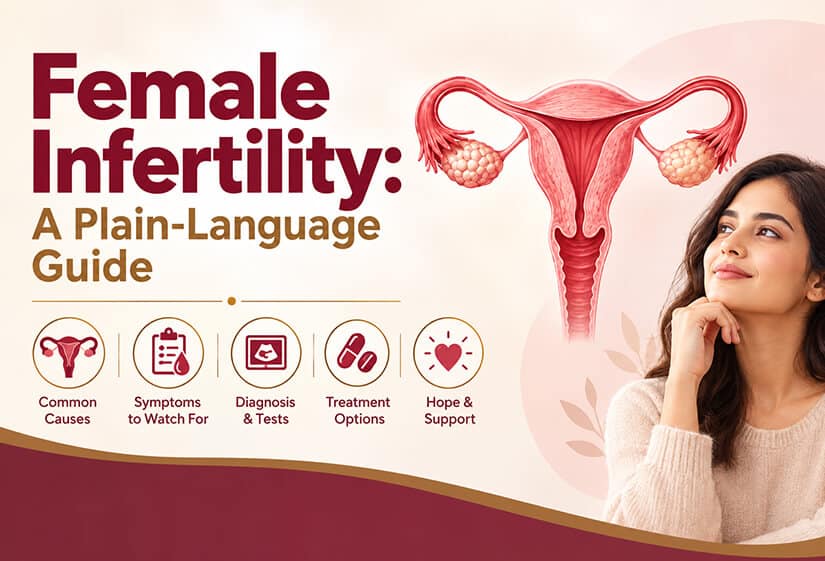
Female Infertility: A Plain-Language Guide
You Are Not Alone
Around 1 in 6 couples worldwide face difficulty getting pregnant. In India, fertility problems in female and male partners together affect an estimated 10 to 15 percent of couples of reproductive age. If you have been quietly carrying this worry for months, or years, you are not the first, and you are not alone.
Two things are worth saying clearly at the start. First, difficulty getting pregnant is not your fault. It is not caused by a career, an abortion in the past, birth control pills, or a stressful job. It is a medical situation with medical causes and, in most cases, medical solutions. Second, if you have been asking yourself, “how do I know if I am infertile?” the honest answer is that the only clear sign is not conceiving after trying for a defined period. Most other signals need a doctor to interpret.
This guide explains what female infertility is, its signs, causes, diagnosis, and which treatments actually work. In plain language, from a doctor who sits across from women asking these questions every week.
What Is Female Infertility?
Female infertility is a medical condition where a woman has difficulty getting pregnant or carrying a pregnancy to term because of factors affecting her reproductive system. The medical definition is straightforward.
If You Are Under 35: You are considered to have a fertility problem if you have been trying to conceive without success for 12 months.
If You Are 35 Or Older: The threshold is 6 months, because fertility declines faster after 35.
There are two types of female infertility. Primary infertility means a woman has never been pregnant. Secondary infertility means she has had at least one pregnancy before but is now struggling to conceive again. If you are in the second group, please know: your worry is real, and your case deserves the same careful workup as anyone else’s. Secondary infertility is often brushed off with “but you had a baby before,” and that dismissal costs precious time.
The term female infertility makes it sound like the woman is the problem. In reality, roughly one-third of fertility difficulty comes from female factors, one-third from male factors, and one-third involves both partners or remains unexplained after standard testing. Both partners always need to be assessed.

Signs of Female Infertility
In many women, signs of female infertility are silent. Their periods are regular, they feel well, and there are no outward symptoms. Fertility problems only become clear when they try to conceive, and pregnancy does not follow. So the absence of symptoms does not mean fertility is fine.
That said, some women do have signals worth paying attention to. Read what they could be.
Irregular Or Missing Periods
If your cycle looks like any of the following, an ovulation issue may be behind it:
- Shorter than 24 days,
- Longer than 34 days, or
- Unpredictable from month to month.
If you skip periods entirely for months at a time, this needs investigation. Irregular periods are the single most common outward sign of ovulation disorders, including PCOS.
Very Painful Periods
Some cramping is normal. Pain that stops you working, sleeping or living your life is not. If you have grown used to planning your month around your period, or if painkillers no longer touch it, please do not just accept that as normal. Severe period pain can indicate endometriosis or fibroids, both of which can affect fertility.
Very Heavy Or Prolonged Bleeding
If your periods last more than 7 days, or if you are soaking through protection every hour or two for several hours, this can point to fibroids, polyps, hormonal issues or a bleeding disorder. Heavy bleeding is not something you have to live with.
Hormonal Signs
If you have noticed unexplained weight gain, acne well beyond the teenage years, excess facial or body hair, hair thinning on the scalp, or milky discharge from the nipples when you are not breastfeeding, these can all point to hormonal imbalances that affect fertility. PCOS and thyroid problems are the two most common causes.
Pelvic Pain Or Pain During Intercourse
If you have persistent pain in the lower abdomen, or if sex has become painful, this can suggest endometriosis, ovarian cysts, or a past infection that has caused scarring. These are not things to push through in silence.
Getting pregnant is now easier
Book IVF Consultation
When Should You See an Infertility Specialist?
Timing matters more than most people realize. Seeing a doctor too early means unnecessary tests. Waiting too long can mean losing time that fertility does not have. Here is honest guidance from a female infertility specialist in Delhi.
If You Are Under 35
See a doctor if you have been trying to conceive for 12 months without success. Before 12 months, most couples conceive naturally without intervention. If you are under 35 and it has been less than a year, keep trying and take good folic acid.
If You Are 35 To 37
See a doctor after 6 months of trying. Fertility declines faster after 35, and starting the workup earlier can identify a treatable factor sooner. If you have been on the fence about seeking help, this is your sign to book that first appointment.
If You Are 38 Or Older
See a doctor as soon as you decide you want to conceive, even before you have started trying. There may be quick wins on preparation, and if fertility preservation becomes relevant, timing matters.
If Any Of These Apply To You, See A Doctor Now
Do not wait for the standard timeline in any of these situations. The earlier you know, the more options you have.
- Irregular or absent periods.
- Severe period pain.
- Two or more previous miscarriages.
- Known PCOS, endometriosis, or thyroid problems.
- A history of pelvic infection or pelvic surgery.
- A partner with a known fertility issue.
What Causes Female Infertility?
There are many female infertility causes, and often more than one is at play in the same person. If you are trying to understand your own situation, please remember: identifying the cause is not about assigning blame. It is about knowing where to focus treatment. The most common causes fall into six groups.
Ovulation Disorders
The most common cause. Ovulation disorders mean the ovaries do not release an egg every month, or the eggs do not mature properly. PCOS (polycystic ovary syndrome) is by far the most frequent, affecting an estimated 1 in 10 to 1 in 15 women in India. Thyroid problems, high prolactin, and stress-related cycle disruption also cause ovulation issues.
The good news: ovulation disorders are among the most treatable causes of infertility. If your periods have been irregular and you have been quietly worrying, this is often exactly the kind of problem that responds well to the right treatment. Read more about PCOS and getting pregnant.
Tubal Factors
The fallopian tubes are where the egg and sperm meet. If they are blocked, damaged, or have fluid inside them (hydrosalpinx), pregnancy cannot happen naturally. Past pelvic infections (often chlamydia or tuberculosis in the Indian context), previous surgery, ectopic pregnancy, and endometriosis are the main causes of tubal damage. If you have a history of any of these, tubal assessment is a priority. Read more about blocked fallopian tubes and pregnancy.
Uterine Factors
The uterus needs to be a healthy environment for an embryo to implant and grow. Fibroids, polyps, an unusually shaped uterus, adhesions from past surgery, and a thin uterine lining can all affect this. Most uterine issues can be corrected, and if this is what is standing between you and pregnancy, the fix is usually more straightforward than you might fear.
Endometriosis
Endometriosis is a condition where tissue similar to the uterine lining grows outside the uterus. It causes pain, and it can affect fertility by damaging the ovaries, blocking the tubes, or creating inflammation that makes conception harder. If you have had painful periods dismissed for years, you are not imagining it. Endometriosis is often missed for a decade or more before diagnosis.
Poor Ovarian Reserve
Every woman is born with a fixed number of eggs, and that number falls with age. Poor ovarian reserve means the number and quality of eggs is lower than expected for age. AMH (anti-mullerian hormone) and antral follicle count are the main tests. Poor ovarian reserve becomes more common after 35, but it can also occur in younger women. If you have been told your AMH is low, please do not lose hope: a low number alone does not decide your outcome. Read more about low AMH and pregnancy.
Unexplained Infertility
In around 10 to 15 percent of cases, all the standard tests come back normal, but pregnancy still does not happen. This is called unexplained infertility. It is one of the most frustrating diagnoses to receive, because it can feel like nothing is being addressed. But unexplained does not mean untreatable. Many couples with unexplained infertility go on to conceive, sometimes naturally with time, sometimes with simple treatment.
Things That Do Not Cause Infertility
A few concerns come up in almost every consultation. If you have been carrying quiet guilt about any of these, please set it down.
Past Use of Birth Control Pills. Fertility returns within weeks to a few months of stopping. Long-term pill use does not cause long-term infertility.
A Single Safe Abortion. A properly conducted abortion does not cause lifelong infertility. Unsafe procedures can cause complications that affect fertility, which is a separate issue.
Stress Alone. Stress is not a direct cause of infertility. It can affect cycle regularity in some women, but the idea that “you just need to relax” is not evidence-based.
COVID And COVID Vaccines. No good-quality evidence shows either causes infertility. Both have been studied carefully.
How Is Female Infertility Diagnosed?
A proper fertility workup follows a clear order. Both partners are assessed. Male testing (a semen analysis) is straightforward and should not be delayed. Roughly half of all fertility difficulty involves a male factor, and skipping the male workup is one of the most costly mistakes couples make. If you have been asked to come alone to your first appointment, please bring your partner along.
Step 1: A Full Consultation
The first visit is a proper conversation, not a test. Your doctor reviews your medical history, your menstrual cycle, previous pregnancies or treatments, family history, lifestyle, and your goals. Both partners are seen together where possible. A good first consultation runs 30 to 45 minutes. If you feel rushed in your first appointment, that is a signal worth paying attention to.
Step 2: The Basic Tests
Hormone Blood Tests. AMH (ovarian reserve), day-2/3 FSH and LH, thyroid, prolactin. These give a picture of the hormonal environment.
Pelvic Ultrasound. Checks the uterus, ovaries, and antral follicle count (which is a snapshot of your egg reserve).
HSG. Checks the fallopian tubes and the uterine cavity. HSG is a dye X-ray.
Semen Analysis For The Male Partner. Done at the same time as the female workup.
Step 3: More Detailed Tests If Needed
Not everyone needs every test. Depending on findings, further tests may include sperm DNA fragmentation testing, hysteroscopy, or laparoscopy where endometriosis is suspected. A good specialist explains what each test would show and why it matters for your specific situation. If a test is being suggested to you, ask what result would change the treatment plan. That question alone will tell you a lot.
Female Infertility Treatment
Female infertility treatment is not a single thing. It is a ladder from simplest to most involved, and the right rung depends on your specific findings, age, and preferences. If you have been worried that walking into a fertility clinic means being pushed straight into IVF, please read this section carefully. For many women, IVF is not the first answer, or even the second.
Lifestyle And Preparation
For some couples, weight optimization, better sleep, reduced alcohol and caffeine, stopping smoking, and taking folic acid are enough to shift the picture. Lifestyle is rarely the whole answer, but it is a real part of it, particularly in PCOS and mild ovulation issues. If you have been told to “just lose weight and it will happen,” that advice on its own is incomplete. Lifestyle changes work best alongside proper medical assessment, not instead of it.
Ovulation Induction
Medications (letrozole or clomiphene) to help the ovaries release eggs regularly, combined with timed intercourse or ultrasound follicle monitoring. This is the first-line treatment for PCOS and mild ovulation issues. Success rates in the right couples are good, and many women conceive within the first two or three cycles.
IUI (Intrauterine Insemination)
Prepared sperm is placed directly into the uterus around ovulation. Useful for mild male-factor issues, unexplained infertility, and some couples after ovulation induction has not worked. IUI is more affordable than IVF and is often the right next step before IVF is considered.
IVF (In Vitro Fertilization) And ICSI
Eggs are collected from the ovaries and fertilized with sperm in the lab. Resulting embryos are grown for 3 to 5 days, then the best one is transferred to the uterus. IVF is the right choice for tubal factor infertility, moderate-to-severe male-factor issues, poor ovarian reserve, endometriosis-related infertility, and cases where IUI has not worked. ICSI is a variant of IVF where a single sperm is injected directly into an egg, used when the male factor is significant.
Surgery
Some conditions need surgical treatment before or alongside fertility care. Fibroids affecting the cavity, endometriosis causing significant pain or ovarian damage, and hydrosalpinx (fluid-filled blocked tubes) are the main examples. Surgery is not always needed, but when it is, timing it correctly matters.
Donor Eggs Or Sperm
When ovarian reserve is very low, or age is significantly advanced, or when male-factor issues are severe (azoospermia), donor gametes can be an option. This is a personal decision as much as a medical one and is discussed carefully. If you have been told donor is your only option, please know that it is worth getting a second opinion before accepting that as the final word.
Ayurveda And Alternative Medicine
This question comes up often in India. The honest answer: general lifestyle advice from Ayurveda around diet, stress, and sleep can support overall health.
For structural causes (blocked tubes, fibroids, adhesions), evidence-based fertility medicine has much clearer outcomes than Ayurvedic treatment. For hormonal causes (PCOS, thyroid, prolactin), combining the two can be beneficial. What matters most: do not delay evidence-based care while experimenting with alternative medications during the years when fertility is highest.
Real Stories from Excel IVF
Three anonymized case studies from women treated at Excel IVF. Names and small identifying details have been changed. Outcomes vary by individual, and no case guarantees the same result for another patient.
A 29-Year-Old with PCOS Told to "Just Lose Weight"
A 36-Year-Old Told to Skip Straight to Donor Eggs
A 33-Year-Old with Blocked Tubes after a Past Infection
Female Infertility and Pregnancy: What Success Looks Like
The chances of successful pregnancy with female infertility are different with different treatment options. Here are ranges from published evidence, keeping in mind that individual results vary.
Ovulation Induction (PCOS Or Mild Issues): 50 to 70 percent cumulative pregnancy over 3 to 6 cycles in women under 35.
IUI: 18 to 20 percent live-birth rate per cycle in women under 35, cumulatively 30 to 45 percent over 3 cycles.
IVF: 35 to 45 percent live-birth rate per cycle in women under 35 at experienced centres, cumulatively 65 to 80 percent over 2 to 3 cycles. Rates decline with age.
Donor Egg IVF: 60 to 70 percent live-birth rate per cycle, largely independent of the recipient’s age.
These are population ranges. Your specific chances depend on age, the cause of the infertility, the quality of care, and how consistently you follow through. Your doctor should give you an honest estimate for your specific situation. If a clinic quotes you a single, very high number without asking about your specifics, that is a signal to look elsewhere.
What You Can Do Right Now?
Small, evidence-based steps matter, whether or not you are already in treatment. If you are waiting for a first appointment or are between cycles, this is a useful list to start from.
- Start Folic Acid. Whether you are trying naturally or through treatment, 400 to 800 micrograms daily reduces the risk of neural tube defects.
- Aim For a Healthy Weight. Being significantly underweight or overweight affects ovulation. A BMI of 18.5 to 25 helps most women.
- Track Your Cycle. Even a simple notes app works. Knowing your cycle pattern gives your doctor useful information.
- Have Intercourse Every 2 To 3 Days. Across the whole cycle. Timing to the exact ovulation day is less important than regularity.
- Stop Smoking. Both partners. Smoking reduces fertility and increases miscarriage risk.
- Reduce Alcohol and Caffeine. Moderation, not zero. Heavy use affects fertility. Modest use is likely fine.
- Do Not Wait If You Have Red Flags. If any signs from Section 4 apply to you, see a doctor now.
Myths Worth Setting Aside
These come up in almost every consultation. If any of them have been quietly weighing on you, each deserves a clear answer.
Myth: Infertility Is Always The Woman’s Fault
Fact: Roughly one-third of cases involve female-only factors, one-third involve male-only factors, and one-third involve both partners or remain unexplained.
Myth: You Just Need To Relax, And It Will Happen
Fact: For couples with real medical causes, relaxation does not correct blocked tubes, PCOS, or a low sperm count. If stress advice was the whole answer, infertility clinics would not exist. Stress management helps quality of life during the journey. It is not a treatment.
Myth: IVF Babies Are Not Healthy
Fact: outcomes for IVF-conceived children, once adjusted for parental age and health, are broadly comparable to naturally conceived children. Millions of healthy children have been born through IVF since 1978.
Myth: If Your Mother Conceived Late, So Will You
Fact: Family history has some effect but does not predict your own timing. Your age and your own ovarian reserve are much more important than your mother’s fertility history.
Myth: Sleeping Position Or Elevating The Hips After Sex Improves Your Chances
Fact: sperm reach the fallopian tubes within minutes. Position afterwards makes no meaningful difference. If you have been holding awkward positions after intercourse, you can stop.
Frequently Asked Questions
The only definitive sign is not conceiving despite trying for the defined period (12 months under 35, 6 months at 35 and above). Some women have other signs like irregular periods, severe pain, or hormonal signals. Many have no symptoms at all. If you are worried, please see a doctor. A basic workup is quick and gives you an answer.
Rough ranges at established Delhi centres: initial workup 8,000 to 15,000 rupees. Ovulation induction cycle with monitoring: 8,000 to 15,000 rupees. IUI: 15,000 to 25,000 rupees per cycle. IVF: 1,50,000 to 2,50,000 rupees per cycle, depending on the protocol. ICSI adds around 30,000 to 50,000 rupees. If you are getting a quote, always ask for a written itemized estimate before starting treatment.
Depends on the cause. Ovulation issues and mild male factor often respond to lifestyle changes and simple medication, and natural pregnancy can follow. Blocked tubes, severe male factor, or advanced ovarian reserve issues usually need IVF. Your doctor should give you an honest estimate specific to your findings.
Yes. Always. Male testing is quick, inexpensive, and non-invasive. Delaying it is a common and costly mistake. A full workup starts with both partners at the first visit.
Yes. A more detailed Female Infertility FAQ blog covers 40 to 50 more specific questions. The link will be added here once published.
When You Are Ready to Talk to Someone
If you have read this far, you are likely at a point where the next step is a conversation with a doctor. That is not the same as committing to treatment. It is simply the first honest look at your specific situation. As a trusted IVF centre in Delhi that many patients across Delhi and NCR travel to, Excel IVF at Shalimar Bagh East offers both-partner assessment, honest counselling, and clear next-step options at the first visit.
You can book a consultation with Dr Rhythm Gupta by calling +91 8920 963 596 or visiting Excel IVF at GNH Excel Hospital, BN 56 East, Shalimar Bagh East, Delhi 110088. Clinic hours are Monday to Saturday, 9 am to 8 pm. First consultations run 30 to 45 minutes.
Whatever you decide, please do not carry this alone. The right conversation early, whether it leads to reassurance or to a clear plan, is nearly always the right next step.

Dr. Rhythm Gupta
Consultant Obstetrician,
Gynaecologist & Infertility Specialist,
MBBS, M.S Obstetrics & Gynaecology
At Excel IVF, we don’t just treat tests and parameters. We partner with you through the emotional, scientific, and medical journey of fertility. Here, Dr. Rhythm Gupta, the leading IVF specialist in Delhi, shares insights from her years in reproductive medicine, breaking down myths, best practices, and what matters most in your path to becoming a parent.
Book a consultation today to understand better and begin your parenthood journey. Call: +91-8920963596 or Email Us: excelivf@gmail.com