Blocked Fallopian Tubes and Pregnancy: Can You Still Conceive?
Written by Susheela Gupta and medically reviewed by Dr Rhythm Gupta, MBBS, MS (Obstetrics & Gynaecology), Fellowship in Clinical ART, Consultant & Fertility Specialist, Excel IVF, Delhi.
Yes, women with blocked fallopian tubes can still get pregnant. Whether it happens naturally, with tubal surgery, or with IVF depends on which tubes are affected, where the blockage sits, and whether one tube is still open. Tubal-factor infertility accounts for around 25 to 35% of female infertility, and modern treatment for it is well-established and effective.
What “Blocked Tubes” Actually Means?
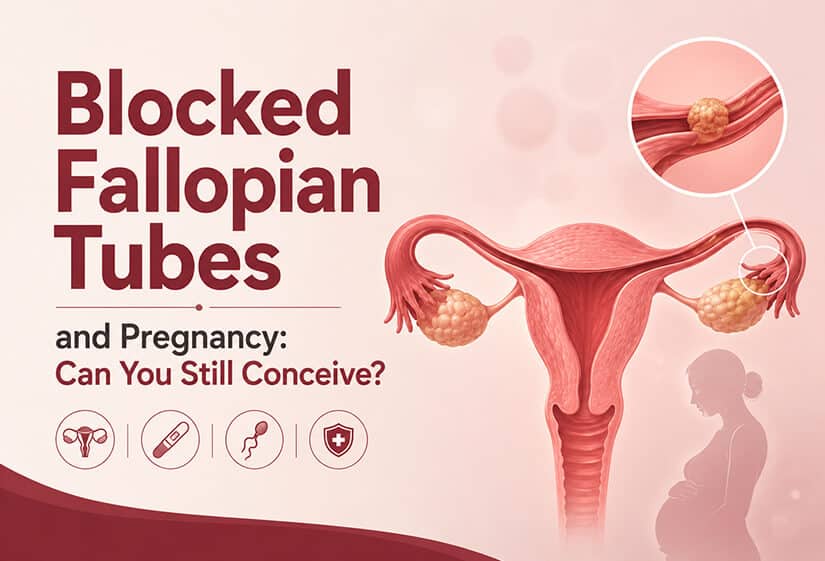
The fallopian tubes are the meeting point of egg and sperm. An egg released from the ovary is picked up by the tube’s fimbriated end, fertilised somewhere along the middle, and carried to the uterus over several days. A blockage anywhere along this path interrupts the process, but not all blockages behave the same way.
- Proximal blockage (near the uterus): Often a debris plug or mild scarring. Around 10 to 30% of tubal-factor infertility involves proximal disease. These respond best to a procedure called tubal recanalisation, with technical success rates typically 80 to 95% across published cohorts and clinical pregnancy rates of roughly 20-40% within 12 months (with substantial variation between studies).
- Distal blockage (far end, near the ovary): Usually the result of past infection (often pelvic inflammatory disease from chlamydia), endometriosis, or previous surgery. When fluid collects in the obstructed tube it is called hydrosalpinx, which is the most consequential pattern because it actively reduces IVF success unless treated first.
- Unilateral versus bilateral: One blocked tube usually allows natural conception, just at slightly reduced odds. Both tubes blocked makes natural conception extremely unlikely without intervention.
If only one tube is affected, your situation is genuinely different. We cover that in detail in our guide on pregnancy with one fallopian tube.

Your Real Chances, in Numbers
Figures from large published cohorts of women undergoing tubal imaging:
- Both tubes patent (open): Around 80% natural pregnancy within two years in women under 35 with no other significant factors.
- Unilateral occlusion (one tube blocked): Around 30% natural pregnancies occur within two years.
- Unilateral hydrosalpinx: Drops significantly to less than 15%, because fluid from the blocked tube can interfere with implantation in the uterus, also teh risk of ectopic pregnancy incareses.
- Bilateral hydrosalpinx: Only around 5% conceive naturally, the lowest of all patterns with increase risk of ectopic pregnancy.
- Age matters enormously. Natural pregnancy rates are typically 25% per month in women under 35 and fall to roughly 5% in women over 40, regardless of tubal status.
Getting pregnant is now easier
Book IVF Consultation
How Tubal Blockage Is Diagnosed
Three tests are used. Hysterosalpingography (HSG) is the standard first test: an X-ray taken while contrast dye is injected through the cervix to visualise the tubes. Hysterosalpingo-contrast sonography (HyCoSy) uses ultrasound instead. Both have about a 15% false-positive rate, which is why a finding of bilateral blockage on imaging is usually confirmed with diagnostic laparoscopy and a dye test, the gold standard. A small bonus: the HSG dye flush itself appears to modestly improve subsequent pregnancy rates, particularly in younger women.
Treatment Options, Matched to the Blockage
Treatment depends on the type of blockage and where it sits.
Tubal Recanalisation is the first choice for isolated proximal blockages: a fine guidewire is threaded through the cervix to reopen the blocked segment. Technical success is high when the blockage is amenable (typically 80 to 95% in published series), with clinical pregnancy rates of roughly 20% within 12 months. There is meaningful variation between studies, and around 2- 50% of recanalised tubes may re-occlude.
Laparoscopic Surgery (salpingostomy or adhesiolysis) can restore distal tubes in selected cases, with better outcomes in younger women and milder disease. See the Laparoscopy for Infertility page for what these procedures involve.
Salpingectomy before IVF is the right choice for hydrosalpinx, because fluid in the blocked tube can reduce embryo implantation. The landmark Scandinavian randomised trial (Strandell et al., Human Reproduction, 1999) showed IVF delivery rates of 28.6% after salpingectomy versus 16.3% without intervention (P=0.045) after the first cycle, with a 3.5-fold benefit in women whose hydrosalpinx was visible on ultrasound. Broader evidence is consistent: untreated hydrosalpinx roughly halves IVF success, and removing or occluding the affected tube before IVF restores rates closer to baseline (pooled relative risks suggest live birth improves by around 50 to 60% and clinical pregnancy by around 25 to 30% after salpingectomy versus no treatment). The effect tends to be most marked in women with bilateral or ultrasound-visible hydrosalpinges.
IVF Directly is the most efficient route for severely damaged tubes, bilateral distal disease that is not repairable, or after failed surgery. Live-birth rates per cycle in tubal-factor cases are roughly 30 to 45% in women under 35 (with significant clinic-to-clinic variation), falling to around 20 to 30% in 35 to 37 year olds and further with age.
Two Patient Pictures, Two Different Paths
The same diagnosis (“blocked tubes”) can lead to very different plans depending on which tubes, what kind of blockage, and the patient’s age. The two composites below show how this plays out.
A typical patient profile (composite of common presentations, not a specific patient)
| Case 2: Priyanka, 36, Bilateral Distal Hydrosalpinx | |
| Presenting picture | Married 5 years, trying to conceive for 3. Regular cycles, occasional dull pelvic discomfort, no severe pain. History of two episodes of pelvic infection in her late twenties. AMH 1.4 ng/mL (low-normal for age). Husband’s semen analysis normal. |
| Imaging findings | HSG showed bilateral distal occlusion with dilated, fluid-filled tubes (bilateral hydrosalpinx, both clearly visible on ultrasound). Diagnostic laparoscopy confirmed the imaging. |
| Treatment plan | Given Priyanka’s age, declining AMH, and the severity of bilateral hydrosalpinx (where natural conception rates are around 5 to 10% and untreated IVF success is roughly halved), the recommendation is laparoscopic bilateral salpingectomy followed directly by IVF, rather than attempting tubal reconstruction or further waiting. |
| What we would expect to see | Post-salpingectomy IVF live-birth rates in this age band are typically 25 to 35% per cycle, with cumulative rates over 2 to 3 cycles approaching 50 to 65%. The consistent meta-analytic finding that salpingectomy roughly doubles live-birth chances in bilateral hydrosalpinx is the basis for moving surgically rather than straight to IVF with the tubes intact. |
| Key learning | With bilateral hydrosalpinx in a woman over 35, time is the limiting factor. Tubal reconstruction is rarely the right answer at this severity, because even successful repair gives low natural pregnancy rates and risks ectopic pregnancy. IVF after salpingectomy is the most time-efficient and effective route. |
Note: The patient profiles are composites drawn from common presentations and published cohort outcomes. They are not specific patients, and any individual’s plan will differ based on their own findings.
When to See a Specialist
If you have been trying to conceive for 12 months (or 6 if over 35 years) and tubal problems are suspected (past pelvic infection, surgery, severe periods, or known endometriosis), have a tubal assessment now. Tubal damage often causes no symptoms until conception becomes the issue, and earlier diagnosis means more treatment choices while age is on your side.
Frequently Asked Questions Blocked Fallopian Tubes and Pregnancy
No. Proximal blockages often respond to tubal recanalisation, after which roughly 20 to 50% of women conceive within a year (some naturally, some with IUI; success varies widely by patient and centre). One blocked tube usually allows natural conception with reduced odds. IVF becomes the most efficient route for bilateral severe disease, hydrosalpinx, or when age and ovarian reserve make further waiting unwise.
Rarely. A mild proximal debris plug occasionally clears spontaneously, and the dye flush during HSG itself appears to mildly improve subsequent conception. But established distal blockage, hydrosalpinx, or scarring from infection or surgery does not reverse without intervention. Waiting indefinitely is rarely a good strategy.
It varies by type. Tubal recanalisation for proximal blockage has typically 80 to 95% technical success and pregnancy rates of around 20 to 40% within 12 months across published cohorts. Laparoscopic distal repair is more variable, with reported live-birth rates ranging widely (anywhere from 10 to 70% depending on disease severity, age, and surgical expertise). Salpingectomy for hydrosalpinx does not restore the tube but roughly doubles subsequent IVF live-birth rates.
Fluid in the blocked tube can leak into the uterus and interfere with embryo implantation. Untreated, hydrosalpinx roughly halves IVF success; removing or occluding the tube before IVF roughly doubles live-birth rates compared with no treatment. This is one of the clearer pre-IVF treatment decisions in fertility medicine.
Take the Next Step
Blocked fallopian tubes are one of the more clearly defined causes of fertility difficulty, and the path forward depends almost entirely on the pattern of blockage rather than the diagnosis alone. A proper imaging assessment, ideally combined with examination and ultrasound for hydrosalpinx, gives a clear answer about which route is right for you.
If you have been told you have tubal blockage, or you have a history that makes it likely, book a consultation with Dr Rhythm Gupta at Excel IVF for a clear assessment and a realistic, personalised plan.

Dr. Rhythm Gupta
Consultant Obstetrician,
Gynaecologist & Infertility Specialist,
MBBS, M.S Obstetrics & Gynaecology
At Excel IVF, we don’t just treat tests and parameters. We partner with you through the emotional, scientific, and medical journey of fertility. Here, Dr. Rhythm Gupta, the leading IVF specialist in Delhi, shares insights from her years in reproductive medicine, breaking down myths, best practices, and what matters most in your path to becoming a parent.
Book a consultation today to understand better and begin your parenthood journey. Call: +91-8920963596 or Email Us: excelivf@gmail.com